

Financial Town: Life & Money Simulator
This project is a scenario-based financial simulation inspired by a volunteer financial literacy program for high school students. Through a “Money Quest” journey, learners make real-life decisions around budgeting, saving, investing, debt, and retirement, experiencing the impact of their choices and building practical money management skills.
Audience: High school students (financial literacy learning experience)
Responsibilities: Instructional design, eLearning development, action mapping, scenario design, storyboarding, visual design, prototyping, and evaluation
Tools Used: Articulate Storyline 360, Vyond, Figma, Gemini, Canva, MindMeister, Google Docs

The Problem
Many high school students lack practical financial literacy skills and have limited opportunities to apply concepts like budgeting, saving, investing, and retirement planning in real-life contexts. Without hands-on experience, financial decisions remain abstract, making it difficult for learners to understand trade-offs, long-term impact, and the consequences of everyday money choices.
The Solution
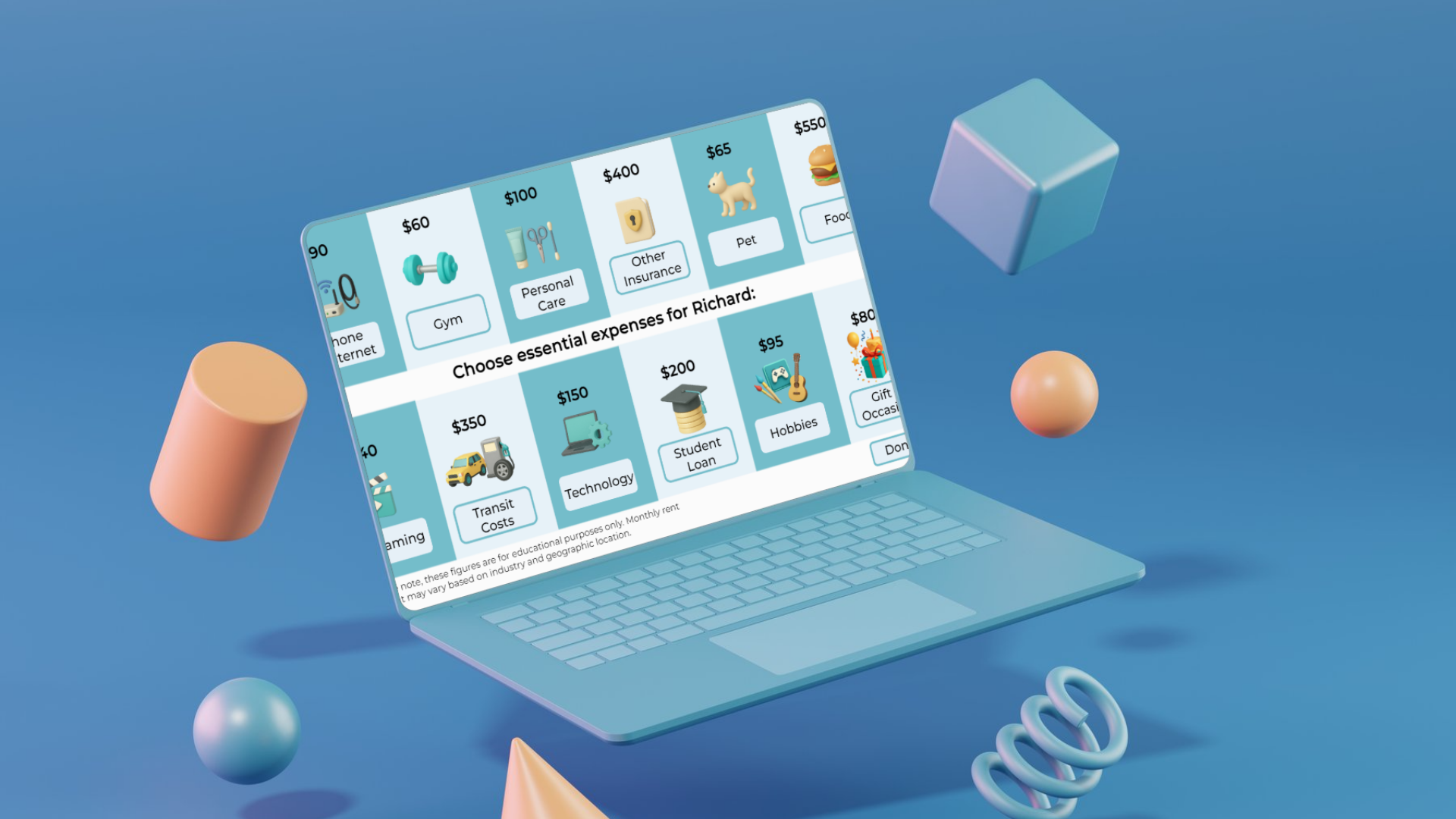
To address this gap, I designed an interactive, scenario-based financial simulation where learners engage in a “Money Quest” journey. In this experience, users make real-world financial decisions—such as managing income, allocating expenses, contributing to savings and retirement, and handling debt—while receiving immediate, personalized feedback. The simulation creates a safe environment for experimentation, helping learners build confidence, understand financial trade-offs, and develop practical money management skills they can apply in real life.
My Process
I wanted this learning experience to be practical and engaging, so I designed it as a life-like financial simulation based on insights from financial literacy workshops for high school students. These workshops covered key topics such as budgeting, saving, investing, and retirement, and I wanted to create a tool that brings all of these concepts together in one experience.
I started by creating a storyboard to map out the learner journey and key decision points. Then, I designed visual mockups and developed an interactive prototype. After refining the experience, I built the full simulation where learners can apply what they’ve learned and test their understanding through real-life financial scenarios.
Action Map
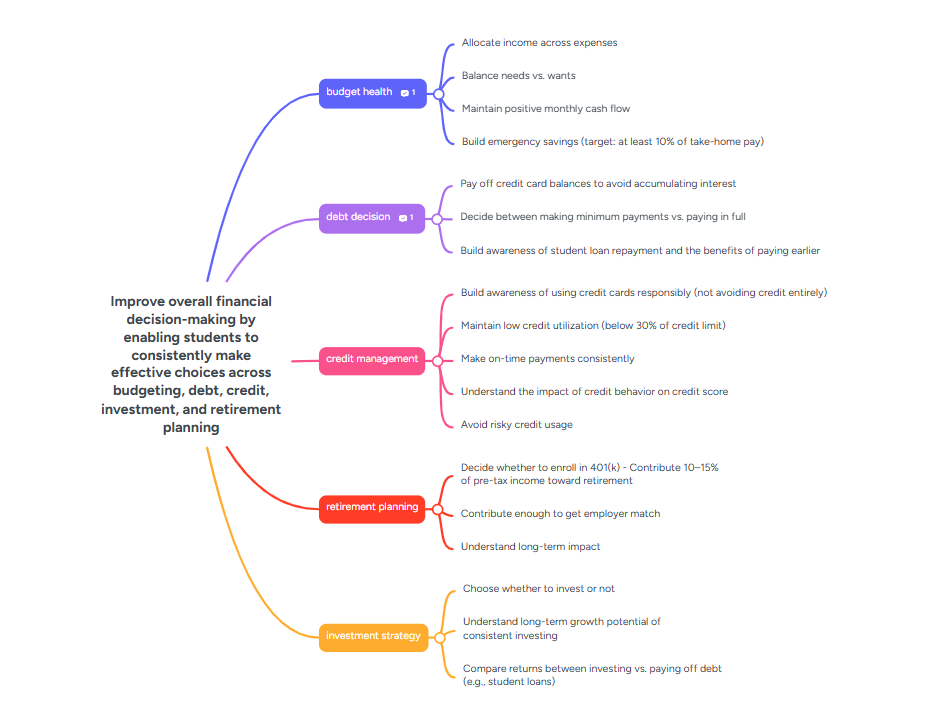
This project was inspired by my experience supporting financial literacy workshops for high school students. Based on those sessions and collaboration with instructors, we identified the key skills students needed to apply after completing the workshops. We focused on real-world actions such as managing a budget, balancing spending and saving, making trade-offs, and planning for long-term financial goals. These actions were built directly into the simulation, allowing learners to practice decision-making in a realistic context. The simulation serves as a capstone experience, helping students test their understanding of all financial topics covered in the workshops and see the impact of their choices in a safe, interactive environment.
Text-based Storyboard
This project is designed as a real-life financial simulation that reflects the types of decisions individuals face in everyday life. I structured the experience around key areas such as housing choices, income and career decisions, 401(k) contributions, and managing essential expenses like transportation, food, and personal needs.
In addition to planned financial decisions, I incorporated unexpected events to mirror real-world uncertainty. Throughout the simulation, learners may encounter situations such as receiving a work bonus, facing emergency expenses, or needing to adjust their budget due to changes in their financial situation. These elements were intentionally included to create a more dynamic and realistic experience.
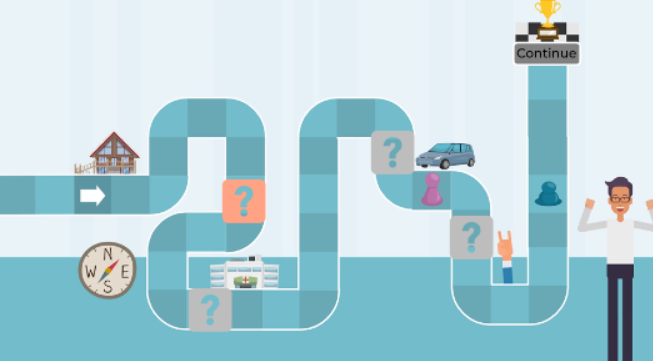
The storyboard outlines how learners progress through a “Money Quest” journey, making decisions at each stage and seeing the impact on their overall financial health. Each scenario is designed to reinforce key financial concepts while allowing learners to experience trade-offs, adapt to changing circumstances, and develop practical decision-making skills.
Visual Mockups
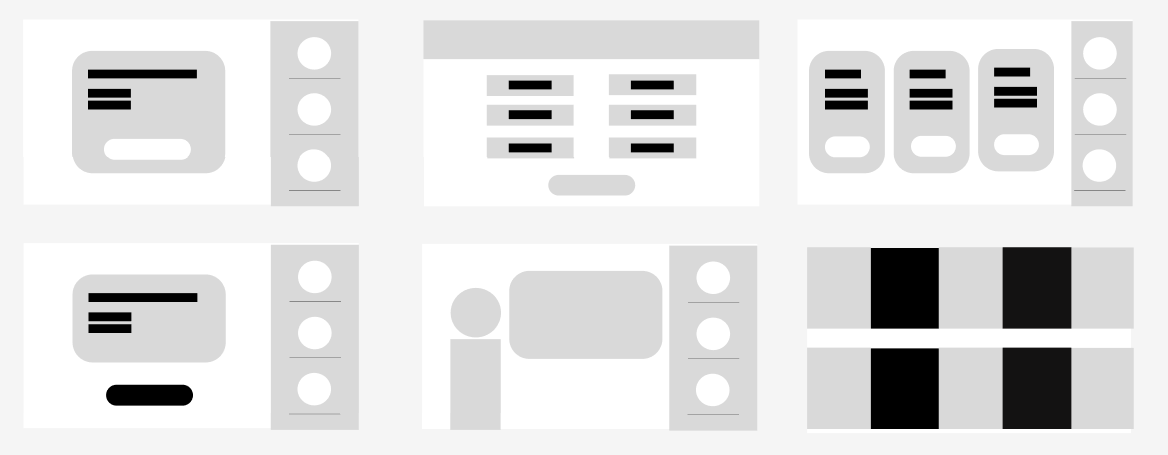
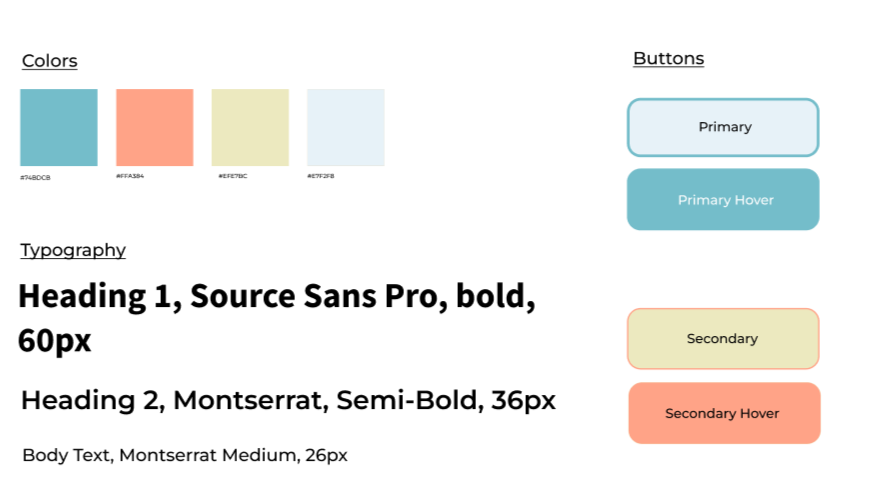
With the storyboard complete, I moved on to creating the visuals using Figma and Canva. Since this project focuses on financial decision-making, I wanted to ensure the interface was clear, intuitive, and easy for high school learners to navigate. I created several mockups, experimenting with different layouts, color schemes, and visual hierarchies.
I focused on designing a clean and structured layout to present financial information in a simple and digestible way. Different sections—such as budgeting, credit, and retirement—were visually distinguished to help guide learners through the experience. Through multiple iterations, I refined the design to balance clarity and engagement, ensuring that learners can focus on making decisions without feeling overwhelmed by the information.
Interactive Prototype
Next, I developed an interactive prototype in Articulate Storyline 360 to test the functionality and overall user experience of the simulation. This stage helped me validate key interactions, decision points, and variable-driven features before moving into full development.
The prototype also gave me space to work through the logic behind the experience, including the final feedback structure, calculation rules, scoring percentages, and category-based results. During this phase, I mapped out how learners would receive feedback across areas such as budget health, credit management, debt decisions, retirement planning, and investment strategy. This process helped ensure that the simulation was not only interactive but also meaningful, measurable, and aligned with the learning goals.
Creating the interactive prototype was a critical step in shaping both the learner experience and the scoring framework that supports the final simulation.
Your Financial Health Dashboard
A key feature I’m particularly proud of is the use of three dynamic progress bars that track learner performance and decision-making throughout the experience.
The first is a Happiness Score, designed to ensure learners consider personal well-being alongside financial decisions. This prevents users from focusing solely on saving at the expense of quality of life, reinforcing the importance of balance.
The second is a Budget Health Score, which tracks whether learners are maintaining positive cash flow. If users overspend and their expenses exceed their available funds, a “budget crash” occurs, requiring them to restart the simulation. This creates a realistic consequence and reinforces responsible budgeting behaviors.
The third is a Credit Usage Tracker, which monitors how learners use their credit card if they choose to open one. It tracks spending and ensures that learners must have sufficient funds to repay their balance. If they choose to make only partial payments or skip payments, the simulation introduces consequences that reflect real-world financial impact.
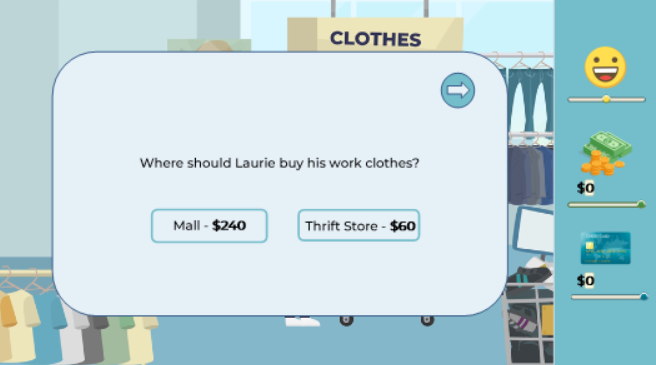
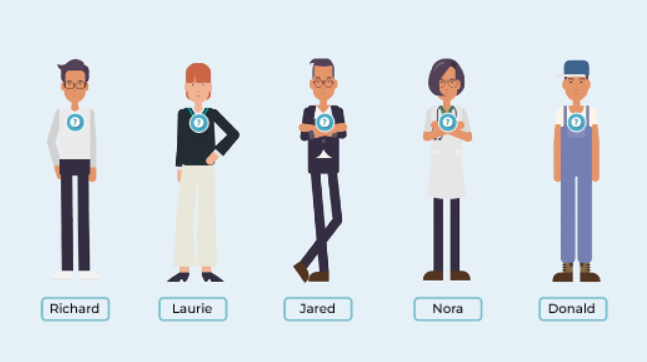
To increase engagement and personalization, I also designed a multi-character scenario system where learners can select different characters to begin the simulation. Each character varies in age and profession, allowing users to experience how financial decisions may differ based on life stage and income level.
In addition to these features, I implemented variable-driven calculations and a scoring system that evaluates learner performance across multiple areas, including budgeting, credit management, debt decisions, retirement planning, and investment strategy. This allows the experience to function as both an interactive simulation and a performance-based assessment of real-world financial decision-making.
Full Development
With the prototype refined, I moved into full development in Articulate Storyline 360. Because much of the interaction logic, score structure, and user flow had already been tested during the prototype phase, I was able to focus on building out the complete simulation experience and ensuring consistency across all scenarios.